ENTERTAINMENT
New Legislation Targets Ticket Scalping with Hefty Fines: Industry Reacts


Lee Min-kyung from TenAsia sounds the alarm on the rapidly evolving entertainment industry, highlighting unseen issues and alerting to threats and changes surrounding the entertainment world.
"Fines 50 times the ticket price? We welcome it with open arms."
This is the reaction from the performance industry following the passage of an amendment to the Performance Act aimed at eradicating ticket scalping through a parliamentary committee. The industry views the amendment, which imposes fines up to 50 times the ticket price on scalpers, as a positive step. However, some critics argue that the amendment only penalizes scalping after the sale has occurred, lacking measures against attempted scalping.
Previously, the Minor Offenses Act included penalties for scalping, but online sales were not subject to criminal penalties. The law, created before the internet era, only penalized scalping at 'entrances of performance venues or stations.' Although a regulation against scalping using macro programs was introduced in 2021, it was criticized for being ineffective due to detection difficulties and lack of online sales prevention measures.
The recently passed amendment replaces multiple proposals submitted by various lawmakers since August last year, with the CSTC drafting a new alternative. Notably, the CSTC's proposal significantly increases penalties compared to previous proposals, which suggested fines 2-5 times the ticket price. The committee's version raises this to over 10 times the previous amount.
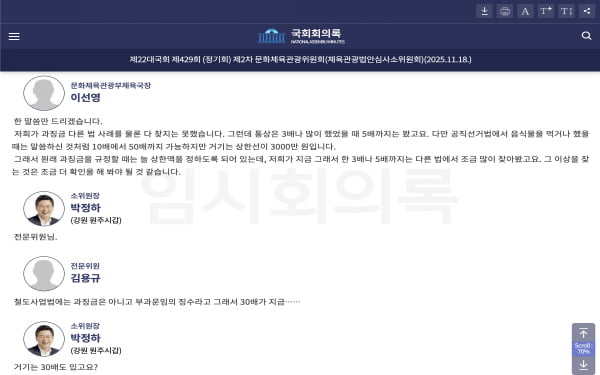
The CSTC increased the fines to strongly convey that scalping is a crime and to deter scalpers. President Lee Jae-myung suggested during a cabinet meeting on the 11th that fines are more effective than criminal penalties, proposing fines 10-30 times the ticket price with a 10% reward for whistleblowers. The '50 times' fine was inspired by the Public Official Election Act, which sets the maximum fine at 50 times the illegal gain.

However, some argue for enhancing the effectiveness of the fines, as they are based on already sold tickets, limiting their ability to prevent scalping attempts. An industry insider noted that while professional scalpers might be deterred, individual 1:1 transactions could be harder to prevent, as unsold tickets cannot be legally penalized even if reported.
A CSTC representative stated that if the amendment is approved by the National Assembly's Legislation and Judiciary Committee and the full assembly, the Ministry of Culture, Sports and Tourism will discuss details to enhance effectiveness before implementation. Lawyer Jang Sung-soo from The All Law Firm suggested that while the ministry will address missing details, not all scenarios will be legislated, recommending management through subordinate regulations for flexibility.
Lee Min-kyung, TenAsia Reporter 2min_ror@tenasia.co.kr